
The Koch Method: Learn Morse Code the Right Way
The Koch Method is the most effective way to learn Morse code. It teaches you to recognize characters by sound at full speed from day one—no charts, no counting, no shortcuts. Just clean, direct learning that builds real fluency.

What Is the Koch Method?
Developed by German psychologist Ludwig Koch in the 1930s, the Koch Method introduces Morse characters one at a time at full speed (typically 15–20 WPM). You start with just two letters. Once you can copy those accurately (90%+ correct), you add one more character. Repeat until you know the entire alphabet, numbers, and prosigns.
The key principle: learn fast, stay fast.
By hearing characters at full speed from the beginning, your brain learns to recognize the sound of each character as a distinct pattern, not as individual dits and DAHs you need to decode.
Why the Koch Method Works
1. Audio-First Learning
Traditional Morse instruction starts with a chart showing dit-DAH patterns for each letter. Students memorize these visually, then try to translate them into sound when practicing.
This creates two major problems:
- You learn to decode Morse code (counting dits and DAHs) instead of recognizing it as sound
- You build a mental translation step that slows you down and limits your maximum speed
The Koch Method skips the chart entirely. You hear characters at full speed from day one. Your brain learns to recognize sounds directly—the same way you learned to read English without thinking about individual letter shapes.
2. Full Speed from Day One
Most Morse training starts at 5–8 WPM, with students counting dits and DAHs. This works at slow speeds, but when you try to speed up, you hit a wall. You've trained yourself to decode, and decoding doesn't scale.
Koch solves this by starting at 15–20 WPM character speed. It sounds intimidating, but it's not. With only two characters to learn at first, your brain quickly picks up the rhythm. By the time you're working with the full alphabet, you've been hearing full-speed Morse for weeks—it feels natural.
3. Gradual Character Introduction
Koch adds one character at a time. You don't move forward until you can copy the current character set at 90%+ accuracy. This ensures every new character is learned thoroughly before adding complexity.
The standard Koch sequence starts with K and M (two very different-sounding characters), then adds letters one by one based on sound similarity and common usage.
How the Koch Method Compares
| Method | Starting Speed | Learning Style | Time to Fluency |
|---|---|---|---|
| Koch Method | 15–20 WPM | Audio-first, recognition | 3–6 months |
| Traditional Chart Method | 5–8 WPM | Visual memorization, decoding | 6–12 months (often plateaus) |
| Farnsworth Method (standalone) | Variable | Speed up gradually | 4–8 months |
| Instant Recognition | 25+ WPM | Full alphabet at once | Steep learning curve |
What Is Farnsworth Timing?
Farnsworth timing is often confused with the Koch Method, but they're complementary techniques. Farnsworth adjusts the spacing between characters while keeping the characters themselves at full speed.
For example:
- Character speed: 20 WPM (how fast each letter is sent)
- Effective speed: 12 WPM (overall copy rate, including extra space between characters)
This gives you more time to think between characters while still training your ear to recognize full-speed sounds. As you improve, you reduce the spacing until character speed and effective speed match.
dit•DAHs implements Farnsworth timing as an optional tool within the Koch Method—you can adjust spacing independently from character speed.
How to Use the Koch Method with dit•DAHs
Step 1: Set Speed
Choose 15–25 WPM character speed. This is your eventual target, so pick a realistic goal for your needs.
Step 2: Add Spacing
Use Farnsworth timing to slow effective rate to 10–12 WPM. This gives thinking time while training recognition.
Step 3: Master Each
Start with K and M. Practice until 90%+ accurate. dit•DAHs tracks this and suggests when to advance.
Step 4: Progress
Add one character at a time. The sequence introduces letters gradually based on sound distinctiveness.
Step 5: Stay Consistent
15–20 minutes daily beats long sporadic sessions. Use Practice Cadence to find your rhythm.
Step 6: Trust Process
Focus on sound patterns, not dits/DAHs. Your brain will learn recognition naturally with practice.
Common Questions
Isn't 15–20 WPM too fast for beginners?
The character speed is 15–20 WPM, but Farnsworth spacing extends the gaps, so overall copy speed is slower. You're hearing fast characters with time to think between them—exactly what trains recognition.
How long to learn the alphabet?
With 15–20 minutes daily, many learners work through all letters and numbers within a few weeks to a few months. Everyone moves at their own pace — consistent practice matters more than speed.
Can I use Koch to improve existing speed?
Yes! If you're at 15 WPM and want 25 WPM, set character speed to 25 and use Farnsworth spacing to slow effective rate. Gradually reduce spacing as recognition improves.
What if I struggle at first?
Struggling initially is normal with just two characters. Use Farnsworth spacing to slow effective rate to 10 WPM while keeping character speed at 18 WPM. This approach helps your brain build the right sound associations with more time to process each character.
How dit•DAHs Implements the Koch Method
- Adjustable character speed: Set your comfortable full-speed target (15–40 WPM)
- Farnsworth spacing: Control gaps between characters independently from character speed
- Progress tracking: See accuracy in real time and know when you're ready for the next character
- Flexible practice modes: Letters, numbers, prosigns, words, and full QSOs
- Audio-first interface: No visual distractions—clean, precise Morse tones
Recommended Start: 18 WPM character speed, 12 WPM effective (Farnsworth). This gives thinking time while training your ear.
Common Mistakes to Avoid
1. Moving Too Fast
Don't add characters until you're hitting 90%+ accuracy. Rushing creates gaps in your foundation.
2. Practicing Inconsistently
15 minutes daily beats 2 hours on weekends. Regular practice builds muscle memory and reinforces recognition.
3. Falling Back on Charts
If you catch yourself decoding dits/DAHs, stop. Refocus on the sound of the character. Trust the process.
4. Skipping Farnsworth When Needed
If struggling, use Farnsworth spacing. There's no shame in extra time between characters while building recognition.
Earn Your Koch Method Certificate
Complete all 40 characters and dit•DAHs generates a personalized Koch Method completion certificate—print-ready and verifiable by QR code.
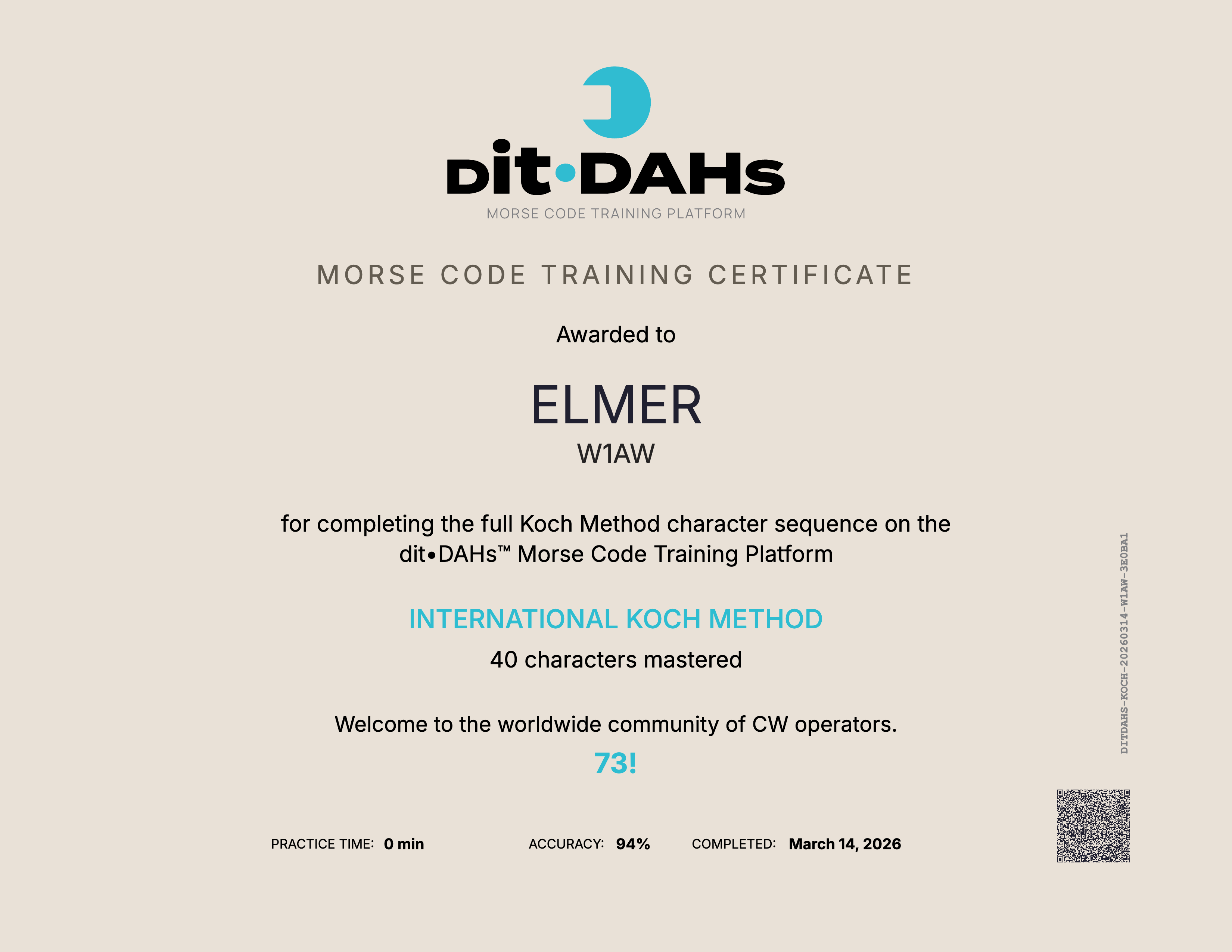
Sample certificate. Your name and callsign appear on your certificate.
Ready to Start Learning?
dit•DAHs implements the Koch Method with a clean, focused interface. No ads, no distractions—just effective Morse code training.
Start Practicing Free →Questions about the Koch Method? Contact support@ditdahs.com